Transfer
Transfer refers to the process of moving a specified amount of a designated currency from a creditor account to a debtor account.
- Supports direct transfers between accounts within the same network. For example: transferring USDT on the ERC20 network to another USDT on the ERC20 network.
- Supports automatic routing for the same currency across different networks. For example: transferring USDT on the ERC20 network to USDT on the TRC20 network.
- Does not support transfers between different currencies, which requires a trade. For example: transferring USDT to BTC.
A Transfer Order is used to describe the specific details of a transfer, including its purpose and status.
When initiating a transfer order, at least the four essential elements must be specified: creditor account, debtor account, currency name, and transfer amount.
Execution of Transfers and Transfer Networks
If two accounts are within the same transfer network, they can directly transfer funds to each other. Examples include SWIFT, ACH, Wise, UnionPay, AliPay, and Blockchain.
A transfer network consists of three elements:
- Network: An abstract concept identified by
network_id, used to distinguish different transfer networks. The internal workings of the transfer network do not need to be concerned with. - Address: The recipient address within the network, identified by
address, which always belongs to a specific network. - Account: An account consists of multiple addresses belonging to various networks, allowing deposits and withdrawals from these addresses.
Basic assumption of transfer networks: Any two addresses within the same network can transfer funds to each other.
A real transfer network might look like the following diagram, where red dots represent networks, blue dots represent accounts, and green dots represent addresses.
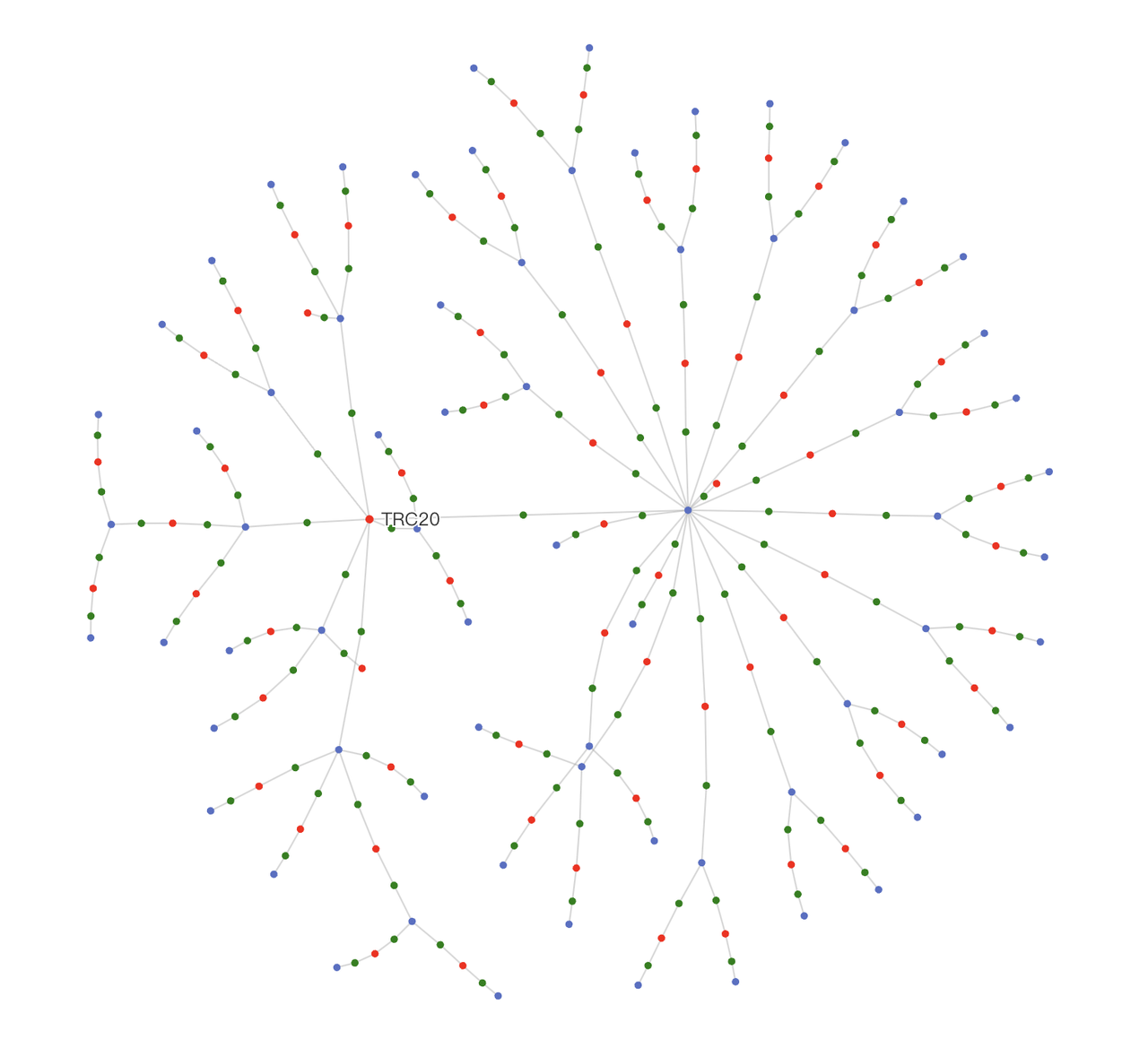
From a graph theory perspective, the transferability between all addresses within the same network forms a complete graph. This complete graph can be equivalently represented as edges from all nodes to a virtual super node.
If funds cannot be directly transferred from the creditor account to the debtor account, a series of intermediate accounts must be used as intermediaries to complete the transfer through various transfer methods.
A transfer requires planning a path from the transfer network graph to serve as the flow path for the funds.
We need to introduce a Transfer Controller to oversee the execution of the transfer process. Additionally, a database is required to persist the transfer order status, ensuring that either party can resume the order after recovering from an unavailable state.
Account Terminal
- During initialization, write Account Address Info into storage.
- Implement "Transfer" (
TransferApply) and "Reconciliation" (TransferEval) interfaces for each network. - The transfer interface initiates a transfer and returns the result synchronously.
- The initial state of the transfer is
INIT. - Only one step is performed at a time, returning the next state, which can be customized and polled by the controller.
- If an exception occurs and it is not a special error, the controller is allowed to retry the poll.
- After the transfer initiation process is complete, return
COMPLETE. - If an unrecoverable exception occurs, return
ERROR.
- The initial state of the transfer is
- The reconciliation interface queries and confirms whether a specific transfer has been received, returning the result synchronously.
- Does not handle writing the transfer order status into storage. (This logic is delegated to the controller to simplify the process)
Transfer Controller
Implemented by @yuants/app-transfer-controller, it can be deployed directly.
- Does not handle creating transfer orders, only updating them.
- Monitors new transfer orders; if there is no planned path, it plans a transfer path for the process and writes it into storage. (Manual optimization of this planning result is allowed)
- According to the planned transfer path, sends transfer and reconciliation instructions sequentially to the accounts along the path to ensure the smooth execution of the entire process.
- When the transfer or reconciliation interface returns
ERROR, it determines that recovery through retries is not possible and requires manual intervention, initiating an alarm. - Initiates an alarm when the entire transfer process times out.
Account Address Info
Account Address Info is the information that needs to be written into the database during the initialization of the account terminal.
| Field Name | Description | Example Value |
|---|---|---|
network_id | Network ID | "ERC20" |
address | Address ID | "0x123456" |
account_id | Account ID | "VENDOR/USER_ID" |
currency | Currency Name | "USDT" |
Transfer Network Info
Transfer Network Info is information that needs to be manually written into the database.
| Field Name | Description | Example Value |
|---|---|---|
network_id | Network ID | "ERC20" |
currency | Currency Name | "USDT" |
commission | Estimated Fee | 20 |